Hair loss affects roughly 50 million men and 30 million women in the United States — and for most, it’s deeply personal. Whether it’s a receding hairline, thinning on top, or diffuse shedding, hair loss affects self-confidence, professional appearance, and quality of life in ways that are hard to overstate.
The treatment landscape has expanded dramatically. Beyond Rogaine (minoxidil) and Propecia (finasteride), which have been the standard for decades, PRP hair restoration has emerged as one of the most promising non-surgical options available — one that works with your body’s own biology rather than against it.
What Causes Hair Loss?
The most common type of hair loss in both men and women is androgenic alopecia — pattern hair loss driven by genetics and the hormone DHT (dihydrotestosterone).
DHT binds to receptors in genetically susceptible follicles and causes them to miniaturize over time — producing progressively thinner, shorter hairs until the follicle eventually becomes dormant. The follicle doesn’t die immediately; in early-to-moderate hair loss, many dormant follicles are still alive and capable of reactivation.
This is exactly where PRP hair restoration comes in — reactivating those dormant follicles with concentrated growth factors from your own blood.
How PRP Promotes Hair Regrowth
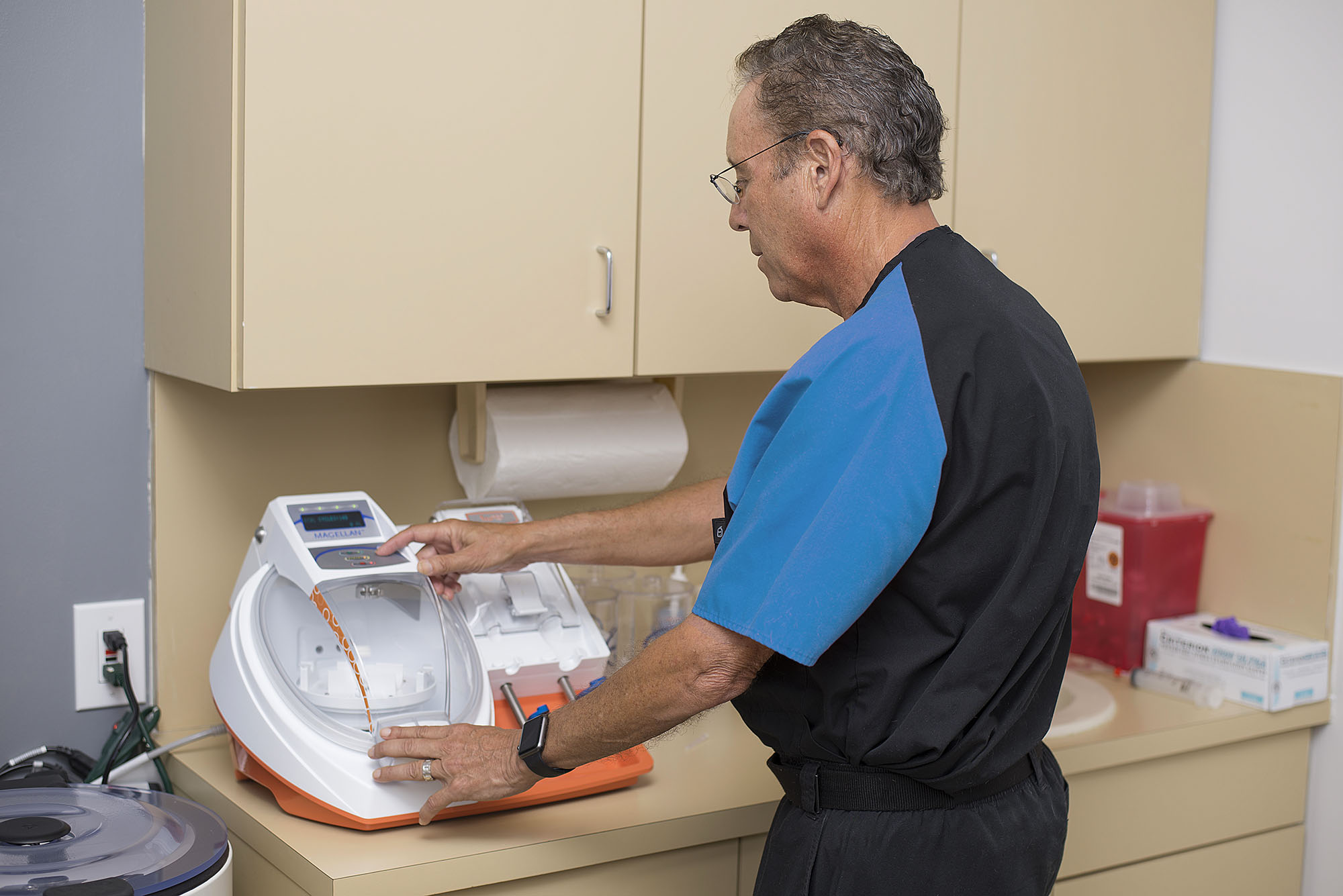
PRP (platelet-rich plasma) is prepared from a small blood draw that is centrifuged to concentrate platelets 4–8x above baseline levels. These concentrated platelets contain powerful growth factors that play key roles in follicle health:
- PDGF (platelet-derived growth factor) — stimulates follicle stem cell proliferation
- VEGF (vascular endothelial growth factor) — promotes blood vessel formation around follicles, improving nutrient supply
- IGF-1 (insulin-like growth factor) — extends the anagen (growth) phase of the hair cycle
- EGF (epidermal growth factor) — stimulates epithelial cell proliferation
- TGF-β — reduces inflammation that can suppress follicle function
When injected into the scalp at the level of the hair follicle, these growth factors:
- Stimulate dormant follicles to re-enter the active growth phase
- Strengthen weakened, miniaturizing follicles
- Improve blood flow to the scalp (follicles need good vascularization)
- Reduce inflammatory processes that accelerate hair loss
The result is gradually thicker, denser, healthier hair — produced by follicles that were previously underperforming.
At LifeBoost MD, the PRP is prepared using a high-quality centrifuge system to ensure consistent platelet concentration, and injections are placed at the precise follicular level using a systematic technique.
What the Research Shows
Multiple randomized controlled trials and systematic reviews have demonstrated PRP’s effectiveness for androgenic alopecia:
- A 2019 meta-analysis in Dermatologic Surgery found PRP significantly increased hair count, hair thickness, and hair density compared to placebo
- Multiple studies show PRP outperforms minoxidil alone at 6-month follow-up
- Combination of PRP with minoxidil and/or finasteride produces superior results to any single treatment
- Results are durable at 12 months with maintenance treatments
What Results Look Like (Realistically)
PRP produces gradual, natural-looking results — not overnight transformation. Here’s a realistic timeline:
Weeks 1–4: Hair shedding typically decreases. Some patients see slight increase in shedding initially (this is normal — follicles cycling into growth phase).
Months 1–3: Fine, new hairs begin to emerge in treated areas. Hair feels thicker overall.
Months 3–6: Most significant visible improvement. Hair count and density increase noticeably.
Months 6–12: Continued improvement as existing follicles strengthen and new follicles reach full growth phase.
After month 12: Maintenance treatments every 4–6 months preserve results.
What PRP can achieve:
- Regrowth in areas with thinning or miniaturized hair
- Significant reduction in hair shedding
- Thicker, stronger existing hair
- Slowing or halting further progression of pattern hair loss
What PRP cannot achieve:
- Regrowth in fully bald areas (where follicles are completely gone)
- The same density results as a hair transplant
- Permanent results without maintenance
Who Is the Best Candidate?
PRP works best for:
- Men and women with androgenic alopecia (pattern hair loss)
- Patients in early-to-moderate stages of hair loss (still have miniaturized follicles)
- Those who want to avoid or delay medication (finasteride, minoxidil)
- Patients already on Rogaine or Propecia who want to enhance results
- Women with diffuse thinning (which responds particularly well)
PRP is less effective for:
- Complete baldness (no follicles remaining)
- Alopecia areata (autoimmune hair loss — requires different treatment)
- Hair loss from nutritional deficiency or medical illness (treat the underlying cause first)
Getting Started With PRP Hair Restoration in Boca Raton
If you’re experiencing hair thinning or loss and want to explore non-surgical options, a consultation at LifeBoost MD is the starting point. Dr. Stratt will assess your hair loss pattern, determine your candidacy, and recommend the appropriate treatment protocol.
Free consultations are available. Call (561) 922-9967 or book online today.
Frequently Asked Questions
Most patients notice reduced hair shedding within 4–8 weeks. Visible new hair growth typically begins at 3–4 months, with peak results at 6–12 months. Hair growth is gradual — PRP reactivates dormant follicles, which then take time to produce visible hair.
The standard protocol is 3 sessions spaced 4–6 weeks apart for the initial course, followed by maintenance treatments every 4–6 months. Some patients with more advanced hair loss may need additional initial sessions.
PRP works best for patients with androgenic alopecia (male or female pattern hair loss) who still have living follicles — evidenced by fine, miniaturized hairs rather than completely bald areas. It is not effective for complete follicle loss (fully bald areas where no hair grows at all).
Yes. LifeBoost MD in Boca Raton offers PRP hair restoration for men and women, performed by board-certified physician Dr. Bruce Stratt. Free consultations are available to assess your candidacy.