If you’ve seen an orthopedic doctor for knee pain, shoulder pain, or a tendon injury, you’ve almost certainly been offered a cortisone injection. And for good reason — cortisone works fast, is well-covered by insurance, and provides real relief. But there’s an increasingly important conversation happening in sports medicine and regenerative medicine about what cortisone is actually doing to your joints over time — and whether PRP is a smarter long-term strategy.
Here’s an honest, evidence-based comparison — based on how Dr. Stratt approaches orthopedic PRP therapy at LifeBoost MD in Boca Raton.
How Cortisone Works
Cortisone (a corticosteroid) is a powerful anti-inflammatory. When injected into a joint, it rapidly suppresses the inflammatory cascade — reducing swelling, heat, and pain often within 24–72 hours.
What it does NOT do:
- Repair damaged cartilage or tissue
- Address the structural cause of pain
- Slow the progression of osteoarthritis
In fact, multiple large studies have found that repeated cortisone injections accelerate cartilage loss in arthritic joints. A landmark 2017 study in JAMA found that patients receiving biannual cortisone injections over 2 years had significantly more cartilage loss than the placebo group — with no meaningful improvement in pain scores.
When cortisone makes sense:
- Acute inflammatory flares requiring rapid relief
- Preparing for physical therapy (reducing pain enough to allow movement)
- Short-term symptom management before a definitive treatment decision
- Conditions where short-term anti-inflammatory effect is the primary goal (e.g., bursitis)
How PRP Works
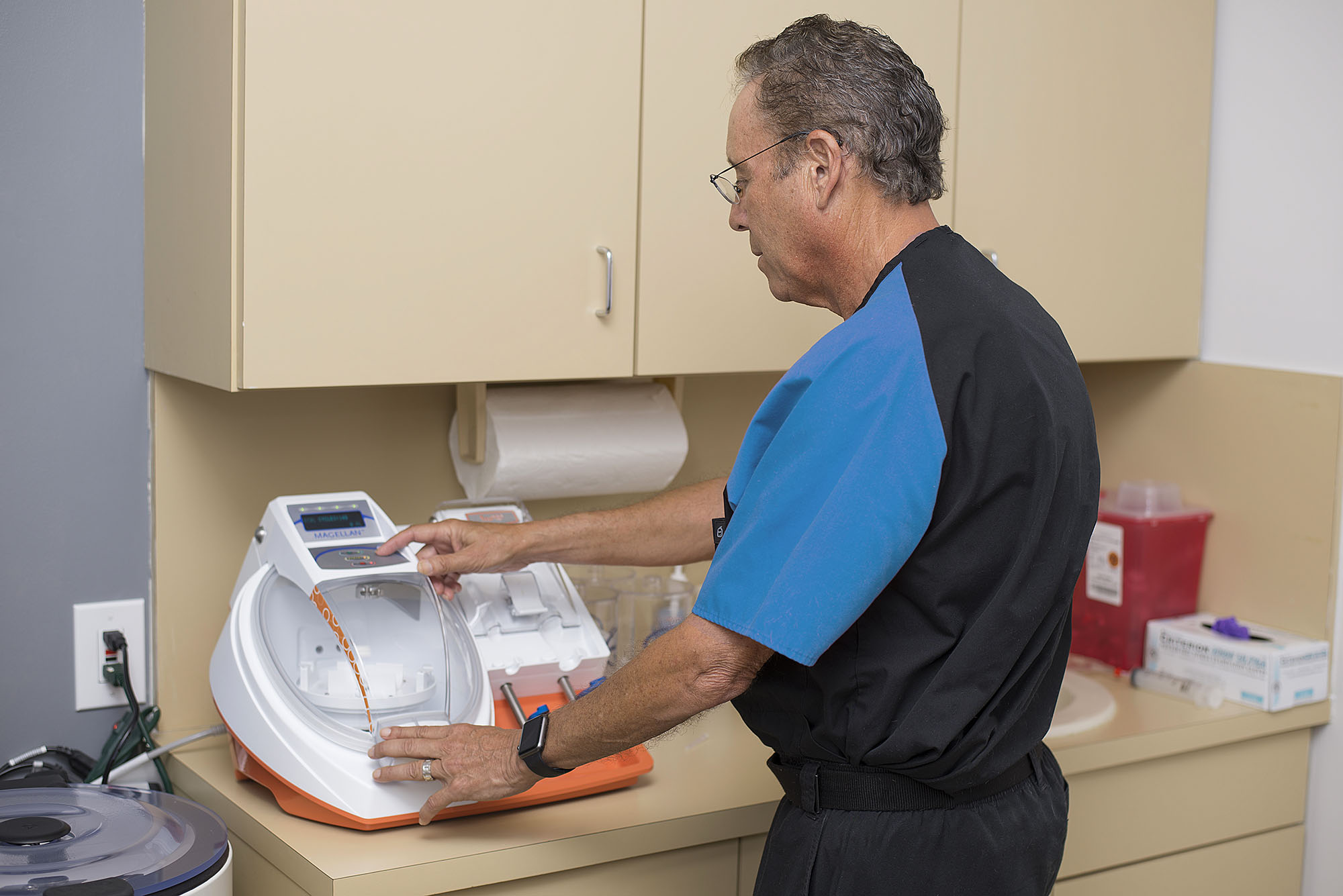
PRP (platelet-rich plasma) takes a fundamentally different approach. Rather than suppressing inflammation, it harnesses and concentrates the body’s own healing factors to stimulate tissue repair.
Platelets contain hundreds of growth factors including:
- PDGF (platelet-derived growth factor) — stimulates cell proliferation
- TGF-β — promotes collagen synthesis and tissue remodeling
- VEGF — stimulates new blood vessel formation
- IGF-1 — promotes cartilage and bone repair
When concentrated PRP is injected into a damaged joint, these factors trigger a controlled healing response that can:
- Stimulate cartilage-producing cells (chondrocytes)
- Promote tendon and ligament repair
- Reduce chronic inflammation through regulatory mechanisms
- Slow the degenerative progression of osteoarthritis
For a detailed overview of how PRP is prepared and administered, see our full page on orthopedic PRP therapy.
Head-to-Head Comparison
| Cortisone | PRP | |
|---|---|---|
| Speed of relief | 24–72 hours | 4–8 weeks |
| Duration of effect | 1–3 months | 12–18+ months |
| Mechanism | Anti-inflammatory | Regenerative |
| Effect on cartilage | May accelerate degradation | May preserve/rebuild |
| Number of injections | 1 (repeat up to 3–4x/year) | 1–3 series |
| Insurance coverage | Usually covered | Usually not covered |
| Best for | Acute flares, rapid relief | Chronic degeneration, long-term repair |
What the Research Shows
Knee Osteoarthritis
A 2021 systematic review and meta-analysis in Arthroscopy analyzing 18 randomized controlled trials found:
- PRP significantly outperformed cortisone at 6 months for pain and function
- Benefits were maintained at 12 months with PRP; cortisone effects had largely dissipated
- No significant safety differences between groups
Lateral Epicondylitis (Tennis Elbow)
Multiple RCTs show PRP superior to cortisone at 1-year follow-up. Cortisone offers faster initial relief but higher recurrence rates. PRP addresses tendon degeneration at the cellular level.
Rotator Cuff Tendinopathy
Studies show PRP comparable to cortisone at 3 months and superior at 6 and 12 months for partial-thickness rotator cuff tears.
Which Is Right for You?
Choose cortisone if:
- You need rapid relief (e.g., a wedding or event in 1–2 weeks)
- You haven’t tried conservative treatment yet
- The condition is acute rather than chronic
- Budget or insurance constraints are a primary concern
Choose PRP if:
- You have chronic joint pain that hasn’t resolved with conservative treatment
- You’ve had cortisone injections before with diminishing returns
- You want to address underlying tissue damage, not just symptoms
- You’re looking for a longer-lasting solution
- You want to avoid or delay surgery
Many patients at LifeBoost MD in Boca Raton come after years of cortisone injections with declining effectiveness. PRP often provides the relief they’d been seeking — because it’s treating the actual problem.
Frequently Asked Questions
Cortisone typically provides relief within 24–72 hours. PRP works more slowly — most patients notice improvement at 4–6 weeks, with full effects at 3 months. The tradeoff is that cortisone's effects are temporary (1–3 months), while PRP addresses underlying tissue damage and can provide 12–18+ months of sustained improvement.
You should wait at least 4–6 weeks after a cortisone injection before receiving PRP. Cortisone suppresses the inflammatory response that PRP needs to initiate healing. Receiving PRP too soon after cortisone significantly reduces its effectiveness.
Multiple studies show PRP outperforms cortisone for knee osteoarthritis at 6- and 12-month follow-up. Cortisone wins on speed of onset, but PRP wins on duration and long-term outcomes. For mild-to-moderate knee OA in particular, PRP has become the preferred regenerative option.
Last reviewed: February 28, 2026